
Westfall Weekly Webinars
These webinars are free to anyone who watches them live and to anyone watching the recordings within two months of broadcast.
Webinar Topics of the Month
June 2026
TOPIC OF THE MONTH
Miscellaneous

July 2026
TOPIC OF THE MONTH
Agile
August 2026
TOPIC OF THE MONTH
Testing
September 2026
TOPIC OF THE MONTH
Process
Upcoming Free Westfall Weekly Webinars
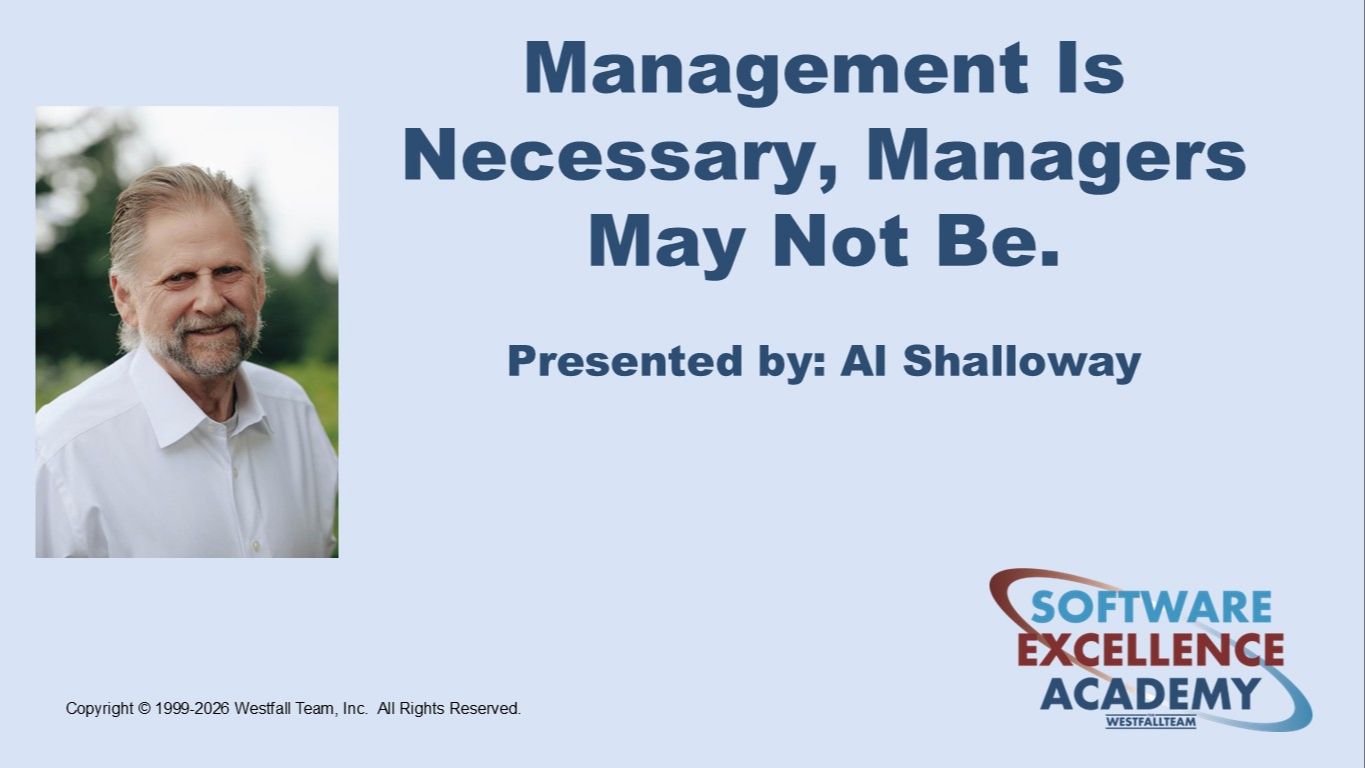
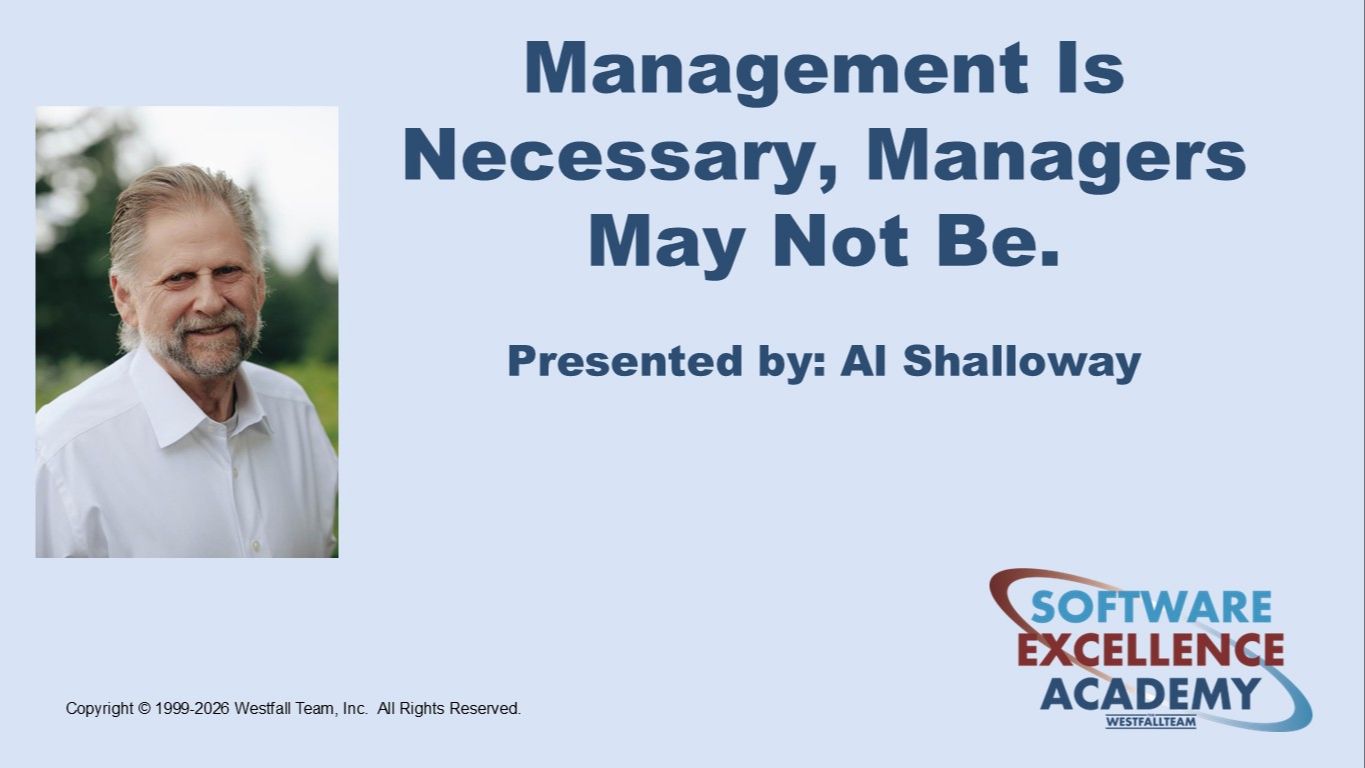
Management Is Necessary. Managers May Not Be presented by Al Shalloway
June 10, 2026, at 12:01 pm Central
Organizations do not become effective simply because talented people work hard. They become effective when someone attends to how the system itself operates.
How do we ensure people are aligned around common objectives?
How do we create alignment across teams?
How do we notice delays, conflicting priorities, and local optimization?
How do we help people learn, improve, and adapt?
How do we create the conditions within which effective work can emerge?
These are all management functions.
In this talk, Al Shalloway explores the role of management from a systems perspective — not as oversight of individuals, but as the ongoing design and improvement of the environment within which people work.
Drawing from Deming, systems thinking, Lean, the Physics of Flow, and Amplio, this session examines:
- Why unmanaged systems naturally drift toward inefficiency
- Why local optimization creates organizational dysfunction
- How visibility, feedback, and coordination shape outcomes
- Why capability development is a core management responsibility
- How organizations can distribute management functions without losing effectiveness
Recent Webinar Recordings
If you need evidence that you watched one of these webinar recordings for recertification units you can request a certificate by sending an email to [email protected]. Please include your name as you want it to appear on the certificate, the title(s) of the webinar(s) you viewed and the date you watched each webinar.
These replays are free to anyone who watches them within two months of broadcast.
To view ALL PAST WEBINARS, join our All-Access Membership today!
Join Our All-Access Membership
The Power of Mentorship: Growing Your Circle of Influence
Presented by: Leslie Weaver
Leadership growth does not happen alone. The leaders who make the greatest impact are often those who intentionally build strong circles of mentorship, connection, and influence. In this webinar, we will explore three levels of mentorship that help leaders grow personally, professionally, and relationally. Together, we will reflect on how the people around us shape our leadership journey—and how we, in turn, influence others.
This session will challenge participants to think beyond their current role and begin building a leadership legacy through intentional relationships and community.
Available Free Until: 08/15/2026
After this date JOIN OUR ALL-ACCESS MEMBERSHIP to access all past webinars.
It’s Their Fault, Not Mine!: Navigating Conflict and Difficult Conversations
Presented by: Zac Jarrard
Projects and process improvement often introduce change in organizations. This can cause conflict and frustration with some stakeholders. Quality managers often need to help teams make decisions and facilitate difficult conversations to move a project forward. This presentation will:
1) examine the causes of conflict
2) provide a framework for navigating conflict and difficult conversations
3) share lessons learned from experience
Available Free Until: 08/08/2026
After this date JOIN OUR ALL-ACCESS MEMBERSHIP to access all past webinars.
View the Webinar Slides
Correction & Corrective Action
Presented by: Linda Westfall
Quality control is all about taking action when tracking our projects, processes, or products reveals one or more issues. Quality control starts with correction, where remedial action is taken to fix the immediate problem. We've got a problem today, and we fix it today. Unfortunately, this correction doesn't prevent recurrence, and that's where we get into trouble. We fix the symptom and call it solved, only for the same issue to happen again later. Long-term corrective action is what actually prevents that. It's the root cause work, the systemic change, the stuff that keeps it from happening again anywhere in the organization. This webinar will discuss both correction and corrective action, which are essential to quality control.
Available Free Until: 08/01/26
After this date JOIN OUR ALL-ACCESS MEMBERSHIP to access all past webinars.
True Shift-Left Does Pay Off
Presented by: Robin Goldsmith
“Shift-Left” is a proven way to deliver higher-quality yet lower-cost software. Except, too much of what’s claimed to be shift-left isn’t really shifting left and delivers far-lower merely-marginal benefits, at best. This interactive session explains what shift-left is meant to mean, why it can provide such big benefits, what’s often claimed to be shift-left instead, why it can only deliver more modest benefits, and how to shift truly left.
- Shift-left lifecycle perspective
- Illusory marginal activity “shift-left”
- Achieving meaningful true shift-left and its bigger benefits
Available Free Until: 07/25/26
After this date JOIN OUR ALL-ACCESS MEMBERSHIP to access all past webinars.
Bringing Quality Control into the Digital Age: Integrating Data, Systems, and Human Insight
Presented by: Sainyam Arora
Quality control has traditionally relied on inspections, audits, and manual data collection. As organizations adopt digital tools and analytics, quality professionals face the challenge of integrating these technologies into established quality control practices without losing the process discipline that ensures reliability. This webinar explores how modern manufacturing and engineering teams can connect traditional quality control methods with data-driven tools to improve decision-making, visibility, and operational performance. Attendees will gain practical insights into how quality control can evolve alongside digital transformation while maintaining strong process foundations.
Available free until 07/18/2026
After this date JOIN OUR ALL-ACCESS MEMBERSHIP to access all past webinars.
6 Steps to Designing a Metric
Presented by: Linda Westfall
After we have defined what we want to measure and why, we need to design a consistent, clear way to collect and report the measurement. This allows everyone to collect data, turn it into information, and interpret it correctly to make better fact-based decisions. In this webinar, attendees will learn the six steps needed to design reliable and valid metrics, including:
- Standardizing definitions for the entities and attributes being measured
- Choosing a measurement function
- Establishing a measurement method
- Defining decision criteria
- Designing reporting mechanisms
- Determining additional qualifiers
Available Free Until: 07/11/2026
After this date JOIN OUR ALL-ACCESS MEMBERSHIP to access all past webinars.
Team Estimation
Presented by: Al Shalloway
Learn a better approach to estimation than estimating story size using Planning Poker.
This webinar will discuss why the common method of how and what to estimate is poor advice.
Estimates should be based more on the value increments to be created and use a method that does not fall prey to the “planning fallacy” - a cognitive bias where people underestimate the time, costs, and risks of future actions, despite knowing that similar past projects exceeded similar estimates.
It will introduce Steve Bockman’s Team Estimation with a callout to James Grenning’s Planning Poker Party (no relation to planning poker). This is a faster, more efficient, and more effective planning method that can be used even in places where Planning Poker is ineffective.
You’ll learn both how to use Team Estimation and be given access to a Lucid Board that enables you to do this remotely.
Available Free Until: 06/27/2026
After this date JOIN OUR ALL-ACCESS MEMBERSHIP to access all past webinars.
78.34% of Metrics Are Made Up
Presented by: Robin Goldsmith
Hopefully, the percentage of metrics that are made up is far lower, but surely is greater than zero. Sometimes it can be intentional, whereas other times it can be inadvertent. Regardless, made-up metrics can have consequences, which can be especially hard to detect due to the lack of reliable measures. This interactive session explores circumstances and impacts where metrics may be made up and suggests better approaches.
- Do only politicians make up metrics?
- Bigger dangers of inadvertently made-up metrics
- Need for and ways to detect and deal with made-up metrics
Available Free Until: 06/20/2026
After this date JOIN OUR ALL-ACCESS MEMBERSHIP to access all past webinars.

The Westfall Team presents regular Software Excellence Academy Webinars.
These webinars are free to anyone who watches them live and to anyone watching the recordings within two months of broadcast.
